Zhixing Machine Zhixing Machine

Why Is CNC Control Used in China Profile Machining Centers?

Time:2026-09-13 Author:Ethan
0%

CNC control has become a practical foundation for many profile machining centers in China. It converts digital drawings into coordinated movements, guiding the spindle, tooling system, and worktable with measured accuracy. This matters when machining aluminum profiles for windows, doors, curtain walls, and industrial frames. A typical operator may load a long profile, select the cutting program, and check the tool path before production begins. The controller then manages drilling, milling, tapping, and positioning with consistent instructions. Precision needs discipline.

So, why is CNC control widely used in profile machining centers? The answer involves productivity, repeatability, and flexible production. Chinese manufacturers often serve varied orders, including short batches and customized profile designs. CNC systems allow technicians to adjust dimensions, hole locations, and machining sequences without rebuilding the entire machine setup. Servo motors and feedback devices also help maintain positioning accuracy during repeated operations. That reduces manual measuring and limits common errors, such as misplaced holes or uneven cuts.

However, CNC control is not a replacement for skilled judgment. A reliable result still depends on machine rigidity, tool condition, program quality, and operator experience. A poor tool offset can damage an expensive profile within seconds. Chips may also affect clamping if the work area is not cleaned carefully. From practical machining experience, automation improves control, but it does not remove responsibility. This article examines why CNC control is widely used in Chinese profile machining centers, while considering its benefits, limitations, and real production requirements.
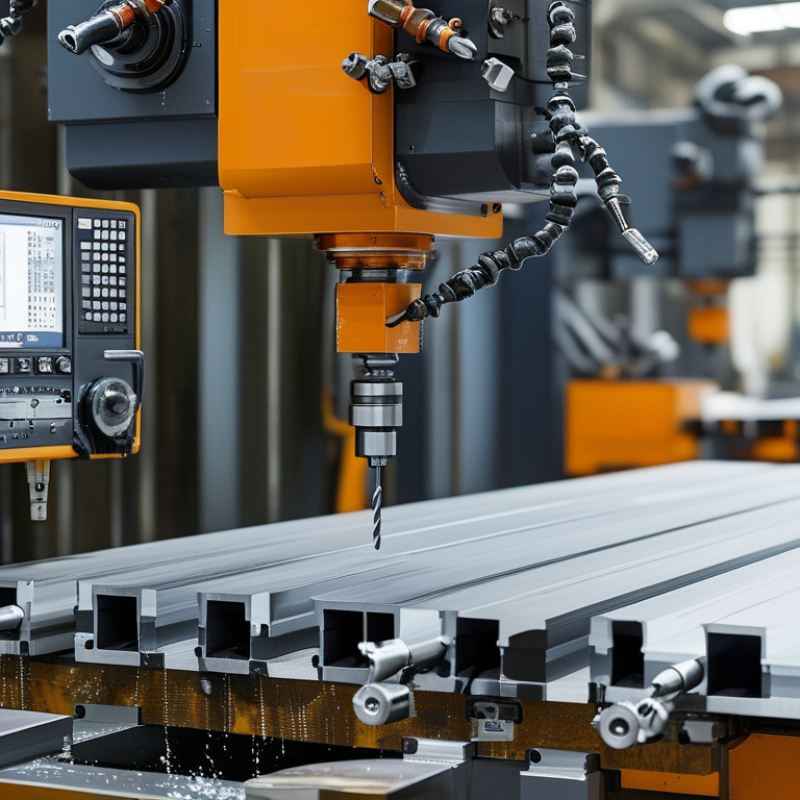
Why Is CNC Control Used in China Profile Machining Centers?

What CNC Control Means in Profile Machining Centers

What CNC Control Means in Profile Machining Centers

CNC control means computer numerical control. It directs each machining movement through programmed instructions. In a China profile machining center, the controller coordinates the X, Y, and Z axes. It also manages spindle speed, feed rate, tool changes, and coolant timing. This creates accurate cuts on aluminum profiles used for doors, windows, frames, and industrial structures. The operator loads a drawing or machining program, then checks the setup before production begins.

A reliable control system reads tool paths and converts them into smooth mechanical actions. It can repeat drilling, milling, tapping, and slotting with consistent positioning. Sensors may detect tool length, door status, or abnormal movement. These functions reduce manual adjustments and improve workplace safety. However, CNC control is not magic. A wrong coordinate, worn cutter, or poorly clamped profile can still produce rejects. Experienced operators inspect the first piece with calipers and gauges. They also compare the result with the drawing. Small mistakes often reveal larger process problems.

Tips: Keep programs clearly named and backed up. Confirm profile length and fixture position before cutting. Start with a slower feed during a new setup. Check chips around the work area, because buildup can affect positioning. Record tool wear regularly. Even advanced controls need careful human judgment.

Why Is CNC Control Used in Profile Machining Centers?

Controlled axes available in common profile-machining configurations

CNC control is used to coordinate tool movement, feed rate, interpolation, and machining sequences with repeatable digital instructions. A three-axis system typically controls X, Y, and Z linear movement, while four- and five-axis systems add rotary axes for more complex profiles, angled surfaces, and reduced repositioning.

How CNC Control Operates During Profile Machining

How CNC Control Operates During Profile Machining

In a China profile machining center, CNC control converts CAD/CAM instructions into coordinated machine movement. The controller reads G-code, checks tool offsets, and sends signals to servo motors. Each axis moves along a calculated path. Interpolation keeps the cutter synchronized around corners, slots, and curved profiles. Feedback scales then compare commanded and actual positions. This correction happens within milliseconds. Spindle speed, feed rate, coolant, and tool changes are also managed automatically. According to the International Federation of Robotics’ World Robotics 2024 report, China installed 276,288 industrial robots in 2023, representing 51% of global installations. This wider automation growth supports stronger demand for precise CNC control.

During profile machining, the controller follows a sequence, not a single movement. It approaches the aluminum extrusion, lowers the tool, maintains cutting speed, and retracts safely. A stable control system can reduce vibration and protect narrow profile walls. However, perfect software cannot repair poor workholding or a wrong tool offset. That is where practical judgment matters. NIST machining research also emphasizes measurement feedback and process control for repeatable production. Operators still need to inspect the first piece. Small errors often appear at corners.

Tips: Set the work coordinate carefully. Check tool length before cutting. Use a slower feed for thin walls. Record actual offsets, not assumptions. A rushed setup can defeat excellent CNC programming.

Why CNC Systems Suit China’s Manufacturing Environment

China’s manufacturing environment rewards speed, flexibility, and measurable process control. CNC systems fit this reality because they convert digital drawings into repeatable cutting instructions. A trained operator can adjust feed rates, tool paths, and tolerances without rebuilding the entire machine. This matters in profile machining, where aluminum frames may change between orders. Workshop experience also shows a practical benefit: saved programs reduce setup errors during repeat production.

The data supports this direction. The International Federation of Robotics reported 276,288 industrial robots installed in China during 2023, representing about 51% of global installations. Its World Robotics 2024 report also recorded 470 robots per 10,000 manufacturing workers in China. These figures indicate a workforce increasingly connected to automated equipment. CNC control adds another layer of coordination, linking machining data with inspection, scheduling, and maintenance decisions. However, automation is not magic. Poor tooling, unstable material, or weak operator training can still produce expensive defects. That limitation deserves more attention.

Tips: Choose a CNC system with clear alarms, offline programming, and stable data transfer. Test one profile family first. Track cycle time, scrap, tool wear, and operator feedback for four weeks. The best configuration may not be the most advanced one. It should match local skills, order variety, and maintenance capacity.

Why Is CNC Control Used in China Profile Machining Centers? - Why CNC Systems Suit China’s Manufacturing Environment

The following table summarizes representative technical characteristics and operating requirements commonly associated with CNC profile machining centers. Actual specifications vary according to machine structure, configuration, workpiece material, and verification method.

Dimension Typical Data or Specification CNC Control Capability Relevance to China’s Manufacturing Environment Practical Manufacturing Benefit
Machine Configuration 3, 4, or 5 controlled axes Coordinates simultaneous or indexed movement of linear and rotary axes through programmed interpolation. Supports a wide range of workpieces, from standard profiles and panels to complex components requiring multi-face machining. Reduces manual repositioning and improves consistency between repeated parts.
Command Resolution 0.001 mm input resolution is common Converts digital program commands into fine movements of the feed system. Suitable for aluminum profiles, architectural components, industrial frames, and other applications requiring controlled dimensional accuracy. Provides finer motion control than manual operation and supports repeatable machining cycles.
Positioning Performance Approximately 0.005–0.020 mm positioning accuracy for many general-purpose machining centers Uses programmed coordinates, feedback devices, compensation functions, and controlled acceleration and deceleration. Helps manufacturers maintain dimensional consistency across high-volume and multi-shift production. Improves interchangeability of parts and reduces rework caused by operator-dependent positioning.
Repeatability Approximately 0.003–0.010 mm on many general-purpose machines Repeats stored toolpaths and motion sequences with consistent axis control. Fits production environments where similar components are manufactured in batches for construction, transportation, electronics, and equipment industries. Supports stable batch quality and simplifies process standardization.
Spindle Speed About 8,000–24,000 rpm is common for profile machining applications Controls spindle speed, direction, ramp-up, and synchronization with programmed cutting conditions. Provides flexibility for aluminum, non-ferrous alloys, plastics, and selected composite materials frequently used in profile processing. Enables efficient material removal while helping maintain surface quality.
Feed and Rapid Movement Rapid traverse commonly ranges from about 10–30 m/min, depending on machine design Manages cutting feed, rapid positioning, acceleration, deceleration, and cornering behavior. Supports short cycle times and rapid changeovers in flexible manufacturing workshops. Increases throughput without requiring continuous manual intervention.
Electrical Compatibility Three-phase 380 V, 50 Hz is widely used in Chinese industrial facilities Integrates machine drives, spindle systems, sensors, safety circuits, and control logic with the available power supply. Matches the electrical infrastructure commonly found in factories and industrial parks in China, subject to site verification. Simplifies machine installation and reduces the need for major electrical conversion equipment.
Program Storage and Transfer USB, Ethernet, and serial communication interfaces are widely used Stores, transfers, backs up, and edits CNC programs and machining parameters. Works with production networks, CAD/CAM workflows, engineering offices, and distributed workshops with different levels of digitalization. Reduces manual data entry and lowers the risk of transcription errors.
Tool Management Automatic tool changers commonly provide approximately 8–24 tool positions Calls tools according to the program and applies tool length, radius, and wear compensation. Supports mixed-order production where several profiles or machining operations must be completed on one machine. Reduces setup time and improves flexibility for small-batch and customized orders.
Workpiece Identification Barcode, QR-code, probe, or operator-input methods may be integrated Links workpiece information with machining programs, offsets, and process parameters. Useful for factories managing many product variants, subcontracting orders, and frequent production changes. Helps prevent program mix-ups and improves production traceability.
Automation Integration Digital I/O, sensors, pneumatic clamps, conveyors, and robotic interfaces Coordinates clamping, door control, lubrication, chip removal, loading, unloading, and safety interlocks. Matches the gradual automation path used by many Chinese manufacturers, from standalone machines to connected production lines. Reduces repetitive labor and supports safer, more consistent operation.
Process Monitoring Alarm history, load monitoring, tool-life tracking, and diagnostic functions Detects abnormal conditions and provides status information for operators and maintenance personnel. Helps factories manage equipment across multiple shifts and identify problems before they cause large batches of defective parts. Improves maintenance response and reduces unplanned downtime.
Quality Verification Accuracy testing commonly follows ISO 230-2 or corresponding national standards Provides controlled axis movements required for machine-tool accuracy and repeatability testing. Creates a standardized basis for acceptance checks, periodic inspection, and supplier quality comparison. Makes machine performance easier to document and verify objectively.
Operator Training One trained operator can supervise programmed cycles and several auxiliary processes, depending on automation level Stores repeatable procedures and reduces dependence on continuous handwheel operation. Supports scalable production in regions with different levels of skilled-labor availability and experience. Shortens the learning curve for repetitive operations and improves process consistency.
Production Flexibility Program-based changeover can often be completed in minutes, excluding tooling and fixture changes Allows operators to load different machining programs, offsets, and cutting parameters. Fits China’s combination of mass production, contract manufacturing, export orders, and customized small-batch work. Improves responsiveness to changing order quantities and product designs.

Note: Numerical ranges are representative industry values rather than universal guarantees. Final performance should be confirmed through the machine builder’s specification sheet, acceptance test, installation conditions, and the applicable accuracy standard.

Key Benefits of CNC Control for Profile Machining

Why Is CNC Control Used in China Profile Machining Centers?

CNC control gives profile machining centers repeatable movement across aluminum frames, doors, rails, and other long sections. The controller converts a digital drawing into coordinated axis motion. It manages spindle speed, feed rate, tool changes, and cutting depth. This reduces manual marking and keeps holes aligned along a 2.5-meter profile. Small errors still matter. A careless datum can spoil an otherwise accurate batch. According to Grand View Research, the global CNC machine market reached about USD 83.6 billion in 2023, with projected growth of 10.3% annually through 2030. That expansion reflects wider demand for controlled, data-based production.

CNC control also improves flexibility. Operators can adjust toolpaths for different alloys, wall thicknesses, and joint designs without rebuilding every fixture. Simulation helps detect collisions before metal reaches the spindle. Real-time alarms can expose tool wear, overload, or abnormal positioning. The International Federation of Robotics reported 276,288 industrial robot installations in China during 2023, representing 51% of global installations. CNC systems fit this increasingly automated production environment, especially when machining data must connect with inspection and scheduling systems. Still, automation is not magic. Poor calibration, blunt cutters, or incorrect compensation can create repeated defects faster. Regular verification, documented offsets, and trained operators remain essential. Sometimes, the simplest check is a measured test cut.

Factors to Consider When Choosing a CNC Profile Center

Choosing a CNC profile center in China requires more than comparing spindle speed and price. In daily production, the machine must match the material, section size, tolerance, and expected batch volume. Ask for test cuts using your own aluminum, steel, or composite profiles. A showroom sample can look perfect. Production rarely does. Check burrs, corner quality, hole position, chip evacuation, and cycle time. Request measurement records from a calibrated inspection method, not only photographs. This practical trial often reveals whether the machine is genuinely suitable.

The CNC control deserves close attention because it connects programming, motion, tooling, and operator decisions. Review interpolation performance, servo response, tool compensation, alarm messages, and program transfer methods. A clear interface reduces training errors, especially when several operators share one shift. Confirm that the controller supports your CAD/CAM output and stores useful machining history. Remote diagnostics may reduce downtime, but data security and access permissions still require written procedures. Do not assume every advertised function is included; verify it during acceptance testing.

Also examine rigidity, thermal stability, fixture design, and maintenance access. A heavy frame may improve cutting stability, while poor cable routing can create avoidable service problems. Ask how accuracy is checked after warm-up and over long profiles. Review spare-part lead times, technician response, manuals, and training quality. Local support can be valuable, yet vague promises are not enough. Put response times and acceptance criteria in the contract. I would also leave capacity for future tooling, even if the initial plan seems fixed. That decision can be imperfect. Real workshops change faster than spreadsheets. On a difficult Monday, those details matter more than a polished demonstration.

FAQS

Why are CNC systems suitable for China’s manufacturing environment?

CNC systems convert digital drawings into repeatable cutting movements. They support fast changes between aluminum frames, rails, and doors. Saved programs can reduce setup mistakes. Automation still needs skilled operators.

What benefits does CNC control provide in profile machining?

It coordinates spindle speed, feed rate, tool changes, and cutting depth. Holes can remain aligned along a 2.5-meter profile. Operators can adjust toolpaths for different alloys and wall thicknesses. Small datum errors still matter.

How can a company test a CNC profile center before buying?

Request test cuts using your own materials and profile sizes. Check burrs, corner quality, hole positions, chips, and cycle time. Measure parts with calibrated equipment. A showroom sample proves little.

Which CNC control features deserve close attention?

Review interpolation, servo response, tool compensation, alarms, and program transfer. Clear messages help operators respond quickly. Offline programming can reduce production interruptions. Do not assume every advertised function is included.

How should production performance be measured after installation?

Track cycle time, scrap, tool wear, accuracy, and operator feedback for four weeks. Compare results across different profile types. Test one profile family first. Four weeks may still miss seasonal variation.

What mechanical details affect profile machining quality?

Rigidity, thermal stability, fixture design, and cable routing influence daily performance. Long profiles need stable support during cutting. Warm-up accuracy should be checked. Heavy frames are useful, but not always decisive.

Why are operator training and maintenance important for CNC systems?

Poor tooling, weak training, or incorrect offsets can repeat defects quickly. Operators should verify tools, datums, and compensation values. Maintenance access should be practical. Automation is not magic.

What support arrangements should be confirmed before purchase?

Confirm spare-part lead times, technician response, manuals, training, and acceptance criteria. Put response times in writing. Remote diagnostics require access controls and data procedures. Promises without details create uncertainty.

Is the most advanced CNC configuration always the best choice?

No. The suitable system matches local skills, order variety, tooling plans, and maintenance capacity. A simpler controller may perform better in a busy workshop. I would leave room for future tooling. The best choice can remain imperfect.

Conclusion

CNC control is the digital system that guides a profile machining center by converting programmed designs into precise movements of cutting tools, worktables, and auxiliary functions. During machining, the controller coordinates multiple axes, manages spindle speed and feed rates, and follows programmed paths to produce accurate profiles with consistent dimensions. This automated process reduces dependence on manual operation and supports efficient production of complex components.

Why is CNC control widely used in profile machining centers? It combines precision, repeatability, flexibility, and productivity, making it well suited to China’s diverse and fast-moving manufacturing environment. CNC systems can handle frequent design changes, batch production, and customized orders while reducing material waste and rework. When choosing a CNC profile center, manufacturers should consider machining accuracy, axis configuration, software compatibility, automation level, machine stability, operator training, maintenance requirements, and overall operating cost. A suitable system should match the required materials, product complexity, production volume, and long-term development goals.

Ethan

Ethan

Ethan is a seasoned marketing professional with a deep expertise in our company's innovative product line. With a passion for sharing knowledge and insights, he takes the lead in regularly updating our corporate blog, where he explores industry trends, product features, and effective marketing......